
What Mark Hyman’s AI Consultation Signals Next
I’ve noticed something recently.
I started asking around—friends of different ages, with different health concerns—and the answer was the same every time. They’re all using AI for health questions. Not occasionally. Regularly. And they swear by it.
One story really stayed with me.
A friend had a concern and brought it up to her doctor, but it was dismissed. Later, she asked AI. It pointed her toward a potential issue and even flagged that a certain medication might not be right for her symptoms. So she went back to her doctor and asked about it again—and this time, the doctor agreed.
That moment stuck with me.
Not because AI replaced the doctor, but because it changed the conversation.
People aren’t turning to AI instead of care. They’re turning to it before care—to understand, to prepare, and to feel a bit more in control before walking into a system that can feel rushed, fragmented, and hard to navigate.
And then I saw something that made this shift even clearer.
Mark Hyman—who I’ve followed for years—built an AI version of his thinking. You ask a question, and you get an answer shaped by his books, his podcast, and his philosophy. It sounds like him, because in many ways, it is.
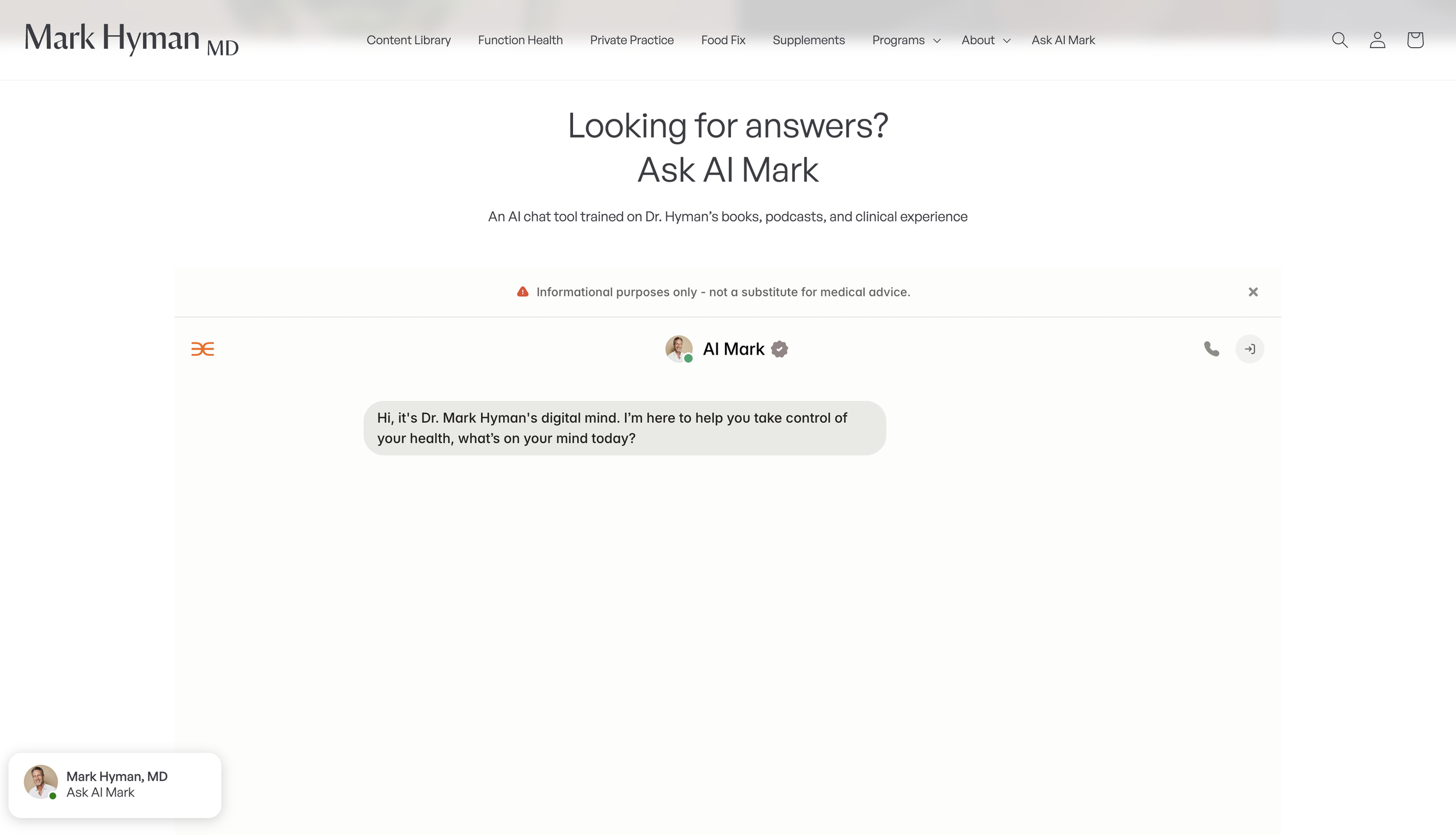
At first, it feels like a feature. But it’s not.
For years, access to someone like him required effort—you had to read, listen, or book time. Now, you just ask.
That’s the shift.
And when you step back, it makes sense. People don’t want more content—they want clarity. They want to understand what might be happening in their body before they walk into a doctor’s office. AI is giving them that first layer.
There’s also something more personal behind his work. He has spoken about losing both his father and his sister to cancer. Experiences like that change how you see medicine. They move you from reacting to questioning, from treating to understanding. And maybe that’s part of why this matters.
But this isn’t just about him.
It’s about behavior.
People are no longer starting their health journey inside the system. They’re starting outside of it—gathering information, asking questions earlier, trying to make sense of things before they commit to next steps.
So when they finally do see a doctor, something is different.
They don’t arrive empty. They arrive with context, with language, and with better questions. And that changes the interaction.
There is, of course, a limit. This is still one voice, one perspective, one way of seeing the body—and health is rarely that simple.
Still, it’s a signal.
Experts are no longer just people you visit. They’re becoming something you can access. And AI is becoming the layer between you and your decisions.
So the question isn’t whether this is happening. It already is.
The real question is:
Who do you trust when the first answer isn’t human?
Because more and more, healthcare isn’t starting in a clinic.
It’s starting in a conversation.
