
What the $22.4 Billion in Philanthropy Really Tells Us
$22.4 billion.
That’s how much the largest donors in the United States gave to charitable causes this year, according to the annual Philanthropy 50 list compiled by the Chronicle of Philanthropy.
It’s an impressive number.
But the real story of philanthropy is not the money.
It’s the motivation behind it.
Over a decade ago, I became fascinated with that question. Who gives? Why do they give? And what experiences shape the causes people choose to support?
That curiosity eventually led me to produce a community television program called Give Back Montreal. It was my first time working in television from CTV Montreal studios. I interviewed philanthropists, spoke with nonprofit leaders, and explored the stories behind the organizations they supported.
What I learned during those conversations was something that rarely appears in philanthropy rankings.
Behind many philanthropic commitments lies a deeply personal story.
In many cases, philanthropy begins with a moment that changes how someone sees the world. A loss. A challenge. A personal experience that creates a deep sense of responsibility to help others facing similar circumstances.
What begins as a private experience often evolves into a public contribution.
Philanthropy becomes a way to transform something difficult into something meaningful.
The Philanthropy 50 list highlights some of the most visible donors of our time, including Michael Bloomberg, who once again topped the list with more than $4 billion in contributions, alongside major philanthropists such as Bill Gates, Warren Buffett, and the estate of Paul Allen.
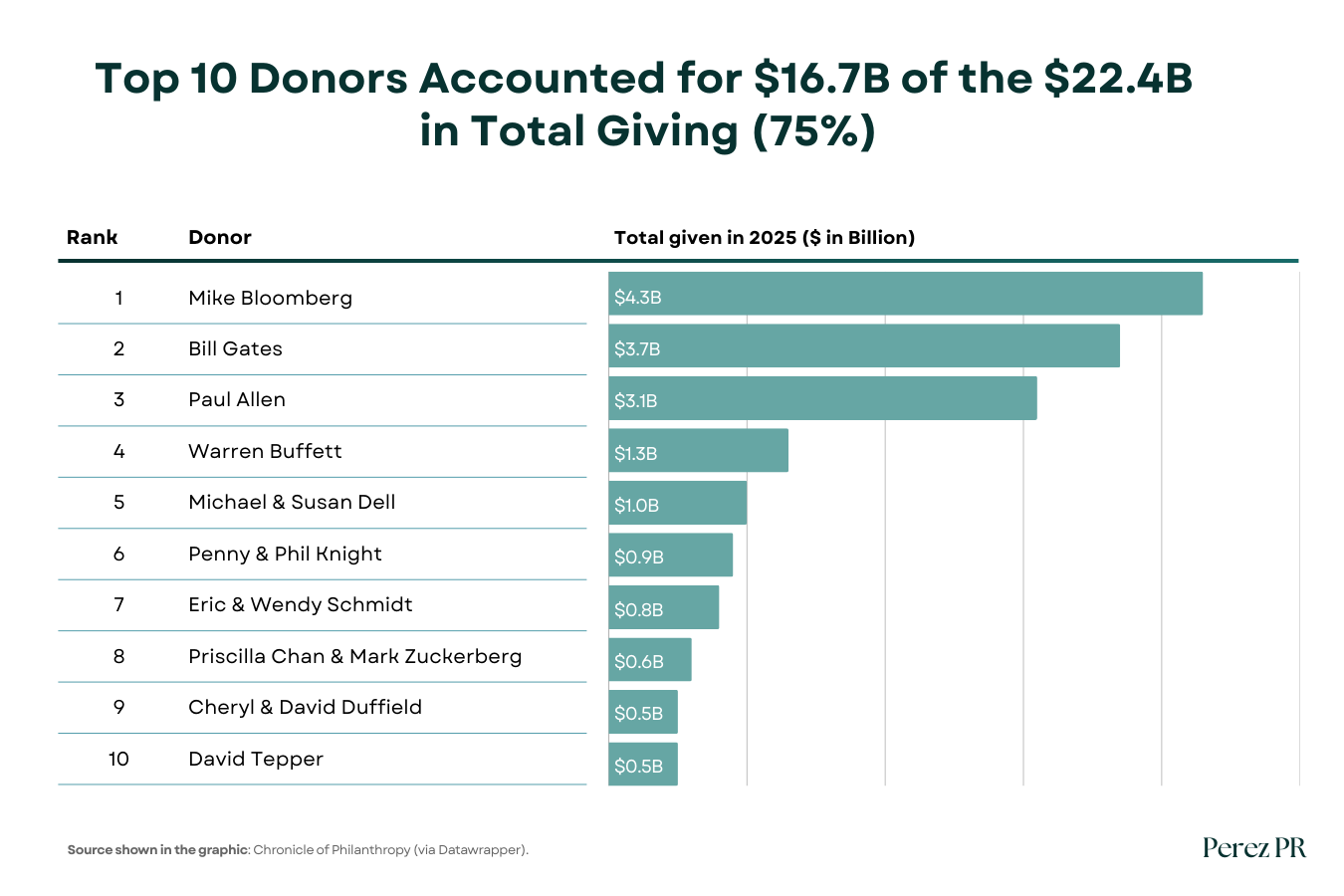
These figures illustrate the scale of modern philanthropy. Yet the rankings also reveal only part of the story.
Increasingly, philanthropy happens through family foundations, donor-advised funds, and long-term commitments designed to distribute capital over many years. Some of the most influential philanthropic actors may not appear in annual rankings at all because their giving strategies are built to operate over decades rather than within a single year.
In other words, the rankings capture the largest visible gifts, but they do not necessarily capture the full ecosystem of giving.
What the data does show clearly is where major donors are focusing their efforts. The largest philanthropic gifts consistently flow toward universities, hospitals, medical research institutions, and foundations working on complex global challenges such as climate change and public health.
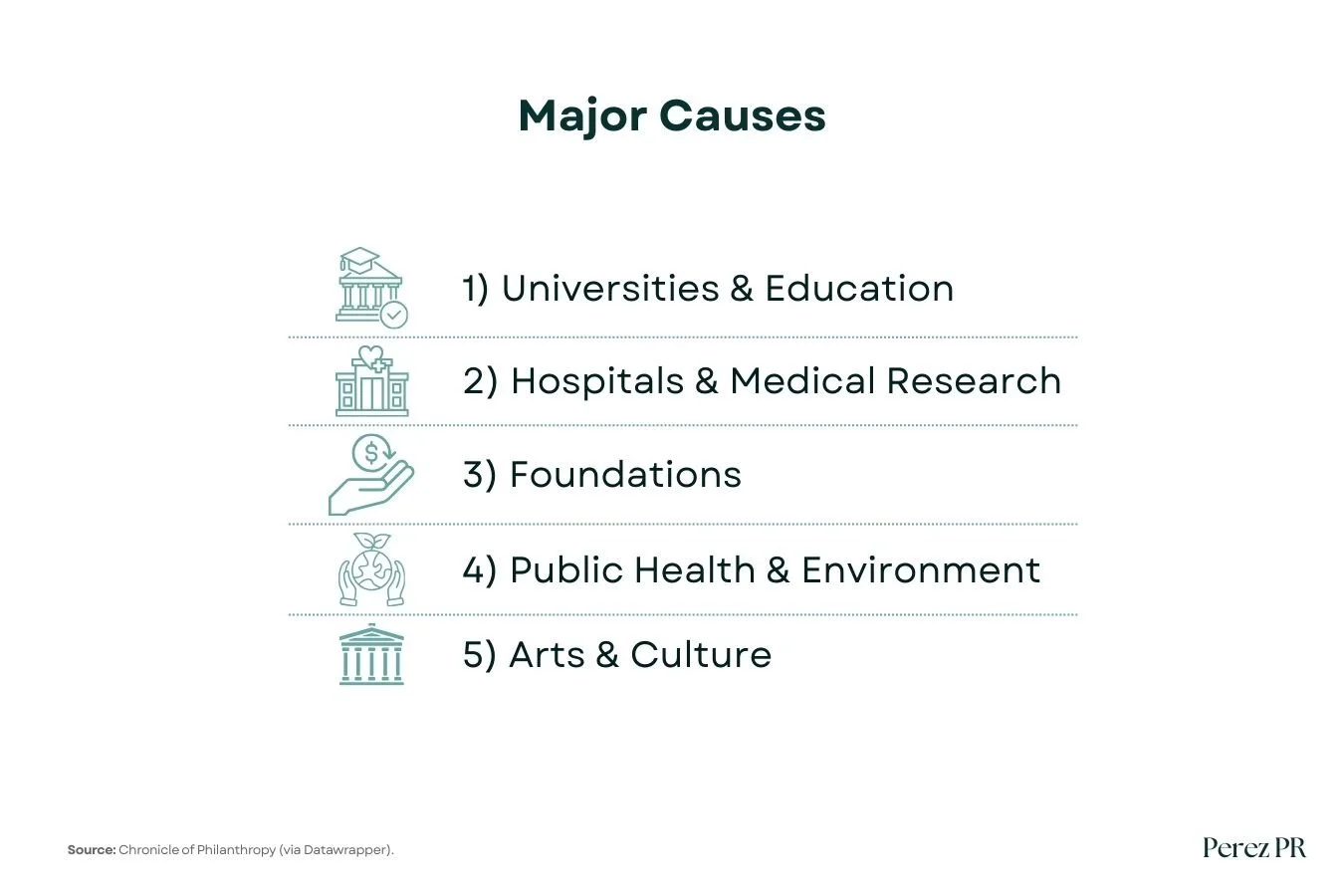
This approach reflects a long-standing philosophy in philanthropy: that private capital can help accelerate solutions to society’s most pressing problems.
Yet one question remains largely unexplored when we analyze philanthropic rankings.
Why Do They Give?
Is philanthropy driven by legacy? Personal experience? A desire to influence social change? Strategic financial planning? In reality, it is often a combination of all of these factors.
In my experience speaking with philanthropists, the most powerful motivations tend to be deeply personal. A turning point in someone’s life often becomes the catalyst for building something that helps others.
Understanding those motivations is not just an interesting observation. It also helps us understand how private capital increasingly shapes the future of public institutions and social innovation.
Another dimension worth exploring is the global context of giving. While American philanthropy is among the most visible in the world, significant philanthropic investment is also taking place across Europe, Asia, the Middle East, and emerging economies. Comparing these patterns could offer valuable insight into how different societies deploy wealth for public good.
The Rise of AI Giving
Looking ahead, technology may also reshape philanthropy in profound ways.
Artificial intelligence has the potential to transform how nonprofit organizations operate, from analyzing donor behavior to improving fundraising strategies and measuring social impact. In the coming years, philanthropists may increasingly invest not only in charitable programs, but also in the technological tools that allow nonprofits to operate more effectively and scale their work.
Philanthropy may evolve from funding individual initiatives to strengthening the systems that allow solutions to grow.
Several trends already point in that direction: larger gifts concentrated among ultra-wealthy donors, more strategic long-term funding models, increased use of philanthropic foundations, and growing investment in technology that amplifies social impact.
But one element of philanthropy will likely remain constant.
Behind every donation, large or small, there is a human story.
The $22.4 billion tells us how much was given.
The more interesting question, and perhaps the more important one, is why.
