
In 2020, I was part of the Founder Institute working on a startup idea.
At the time, everyone in the program kept talking about AI for supply chain management.
The conversations were highly technical, centered around engineers, data scientists, and machine learning models. At the time, it felt like a world far removed from communications, nonprofit leadership, and fundraising.
Back then, artificial intelligence felt like something reserved for Silicon Valley.
Today, with tools like ChatGPT, Claude, or Perplexity, AI is available to everyone, including charities.
And that changes everything.
Because AI fundraising for nonprofits is becoming one of the most powerful tools available to organizations that want to grow their impact.
Importantly, this moment is not about programmers.
It is about leadership.
The Rise of AI Fundraising for Nonprofits
Across the philanthropic sector, organizations are beginning to explore how AI can transform nonprofit fundraising.
Artificial intelligence allows charities to analyze donor patterns, engagement, and communication behavior in ways that were previously impossible.
For nonprofit leaders, this means moving from intuition-based fundraising to data-informed fundraising strategy.
Using AI fundraising tools, charities can now:
• identify new donors more effectively
• analyze donor engagement patterns
• personalize fundraising campaigns
• improve donor retention
• strengthen fundraising messaging
For organizations competing for attention in a crowded philanthropic landscape, AI fundraising for nonprofits is quickly becoming a strategic advantage.
From Traditional Fundraising to Predictive Philanthropy
Historically, fundraising relied on experience and relationships.
Those skills remain essential.
But artificial intelligence introduces a new capability: predictive donor intelligence.
AI systems can analyze large datasets including:
• past donation history
• event attendance
• digital engagement
• philanthropic interests
• wealth indicators
This allows charities to practice what many experts now call predictive philanthropy.
Instead of asking:
“Who should we ask next?”
Nonprofit leaders can begin asking a far more strategic question:
Who is most ready to give now, and how can we engage them meaningfully?
For development teams, this shift can significantly improve fundraising efficiency and donor engagement.
Why AI for Nonprofits Is a Leadership Issue
One of the biggest misconceptions about AI is that it is too technical.
It is not.
The most important conversations about AI for nonprofits should be happening at the executive and board level.
Executive directors, nonprofit CEOs, and boards should be asking:
• How will AI reshape fundraising over the next five years?
• How can AI improve donor relationships without losing authenticity?
• What ethical guidelines should govern AI in philanthropy?
• How do we ensure our organization stays competitive in a rapidly evolving digital world?
These are strategic leadership questions.
Understanding AI fundraising strategy is quickly becoming as essential for nonprofit leaders as understanding digital communications was a decade ago.
AI Is Now Accessible to Every Charity
One of the most exciting developments in the nonprofit sector is that AI tools are now widely accessible.
Artificial intelligence is no longer limited to the largest global institutions.
Today, even small and mid-sized charities can use AI to improve fundraising outcomes.
AI can support nonprofit teams in areas such as:
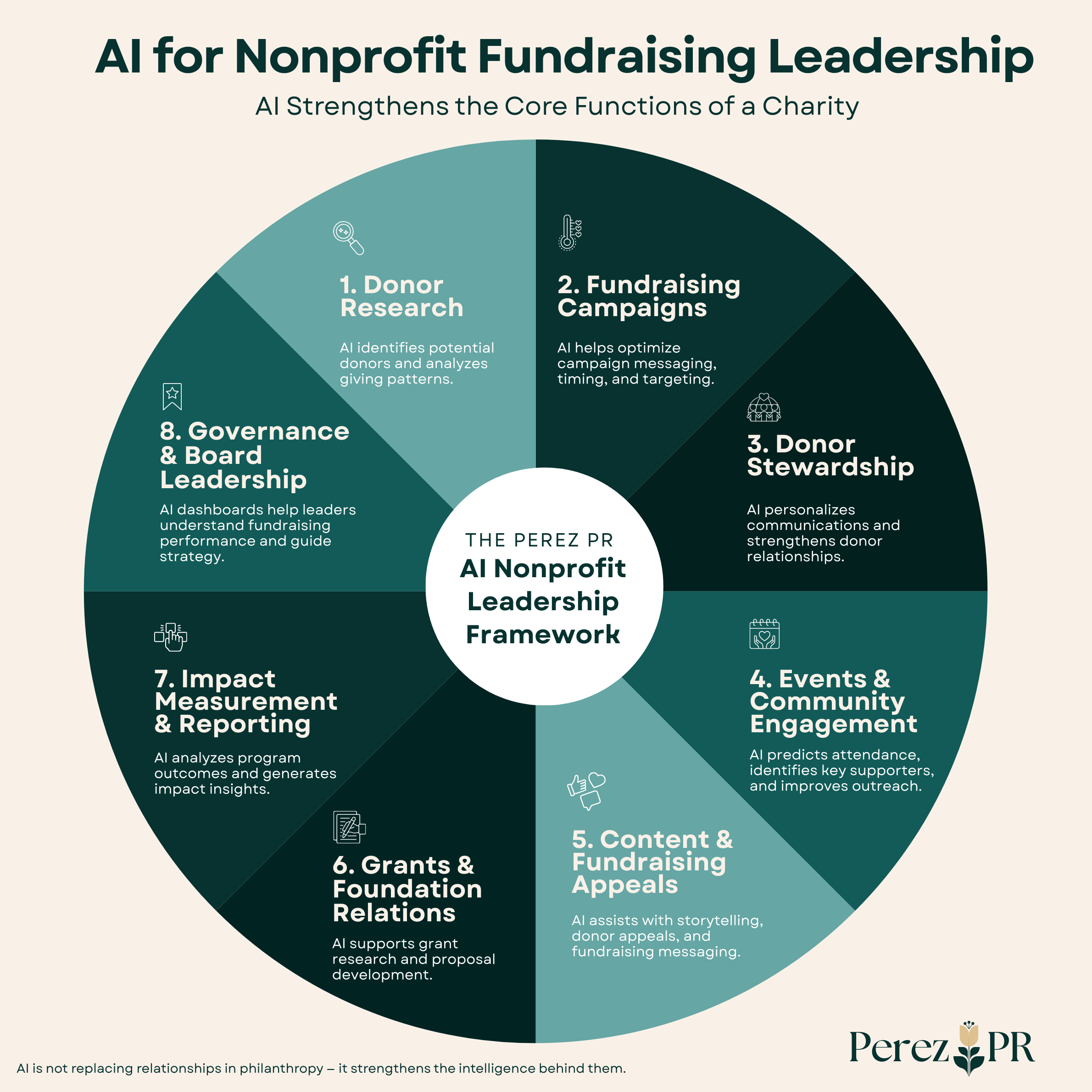
Donor research
AI can generate donor profiles quickly, helping development officers prepare for meaningful conversations.
Fundraising content
AI tools can assist with donor appeal letters, campaign messaging, impact reports, and grant proposals.
Campaign strategy
AI allows charities to test messaging ideas and better understand what resonates with supporters.
Personalized donor communication
AI enables charities to tailor messages to individual donors, strengthening relationships and improving donor retention.
For many organizations, AI fundraising for nonprofits represents one of the most important innovations in modern philanthropy.
Technology Will Not Replace the Heart of Philanthropy
Despite its capabilities, AI will never replace the core of philanthropy.
Relationships.
Trust.
Vision.
The organizations that succeed will not be those that replace people with technology.
They will be those that use AI as a strategic amplifier for human connection.
AI can surface insights.
But leaders build movements.
A Leadership Moment for the Philanthropic Sector
Around the world, charities face increasing pressure to innovate.
Demand for services continues to grow. Donor attention is fragmented. Philanthropists expect greater transparency and measurable impact.
In this environment, AI fundraising for nonprofits offers an extraordinary opportunity.
Organizations that learn how to harness AI for nonprofit fundraising, AI donor intelligence, and AI-powered communications will strengthen their ability to grow, adapt, and lead.
Looking back, I often think about those early conversations in 2020 at the Founder Institute.
At the time, artificial intelligence felt distant.
Today, it sits on every leader’s desk.
The question is no longer whether AI will shape the future of nonprofit fundraising.
It already is.
The real question is whether nonprofit leaders and boards will learn how to use AI fundraising strategies to advance their missions.
The organizations that do will not simply adapt to the future.
They will help build it.
Download the full Executive Brief: AI for Nonprofit Fundraising Leadership to explore how artificial intelligence is strengthening the core functions of modern nonprofits and what boards and executives should understand about the future of fundraising.
Leslie Perez is the Founder and Senior Strategic Consultant at Perez PR, a communications and public affairs advisory firm. She advises charities, foundations, nonprofit leaders, and political organizations on strengthening their communications, fundraising strategies, and public positioning in a rapidly evolving digital landscape.
Her work focuses on the intersection of AI, philanthropy, and public affairs, helping organizations understand how artificial intelligence is reshaping fundraising, donor engagement, and strategic communications. Leslie also advises and trains nonprofit boards, executive teams, and political leaders on how to understand and strategically apply AI in fundraising and communications, helping leadership navigate one of the most important technological shifts facing the philanthropic and public affairs sectors.
Through her advisory work, Leslie helps organizations translate complex ideas into compelling narratives that build trust, strengthen communities, and drive meaningful impact.
